· Harwinder Singh · PMP · 5 min read
Estimate At Completion (EAC) vs Estimate To Complete (ETC) Formulas in Earned Value Management
Four formulas to calculate EAC per PMBOK Guide for project management and the difference between Estimate At Completion (EAC) and Estimate To Complete (ETC) in Earned Value Management (EVM).

EAC vs ETC Formulas in EVM: Due to popular demand :) I’m covering the four formulas for calculating Estimate At Completion (EAC) in Earned Value Management (EVM). The PMBOK® Guide, 6th Edition mentions four different ways of calculating the EAC. We’ll review each of them and reinforce the concepts with the help of a case study.
What is Estimate at Completion (EAC)?
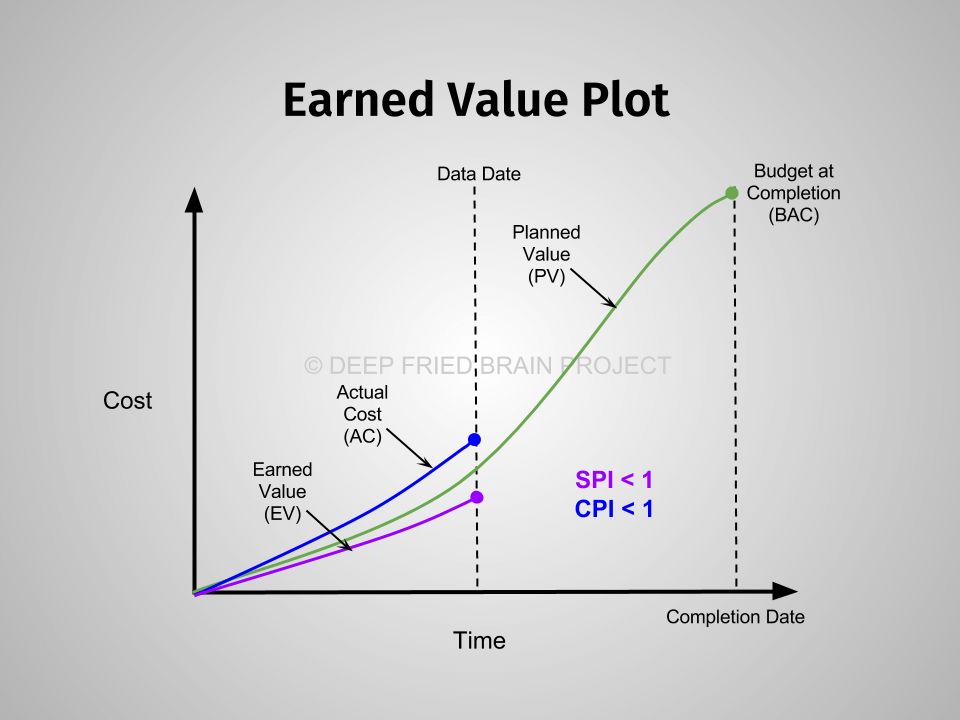
EAC is a “forecast” of the project cost, as the project progresses. Before the start of the project, EAC is the same as Budget At Complete (BAC). However, as the project progresses, EAC may differ from BAC depending upon the project performance.
Case Study
You are a project manager on a really large construction project. Your project requirement is to build a shopping mall on a square piece of land. However, due to economic crisis, the project is scaled down and reduced to building just the boundary walls!! The height of the wall needs to be a staggering 2m. As per the original estimate, it will take 1 week to build one side of the boundary and cost $1000 per side. So, your original budget (BAC) is $4000 and you have 4 weeks to complete the project. Without further ado, let’s get on with laying the bricks.
Four Formulas to calculate Estimate at Completion (EAC)
Now let’s look at 4 scenarios and the corresponding equations to calculate EAC.
1. Original estimate is no longer valid
EAC = AC + bottom-up ETCEither the original estimate was fundamentally flawed or is no longer valid due to change in circumstances (for example change in scope).
Let’s say at the end of the Week 1, you completed one side of the wall and the cost came out to be exactly $1000. However, your customer asks you to raise the height of the walls by another 0.5m, but still complete the project within 4 weeks. You re-estimate the costs. You need to buy more raw material and hire more workers. For the side already completed, you need another $500 to raise its height by another 0.5m. For the remaining 3 sides, you need $1500 per side.
AC = $1000
Bottom-up ETC of the remaining work = $500 + 3 * $1500 = $5000
EAC = $1000 + $5000 = $6000
2. The current cost performance (CPI) will continue in the future
EAC = BAC / CPILet’s say after completing the first side, you spent $1200 instead of the original estimate of $1000/side. The increased cost was due to the fact that it required more raw material to build the wall than what you originally estimated. You think that you are likely to spend $1200 for each of the remaining 3 sides as well.
BAC = 4 * $1000 = $4000
CPI = EV / AC = $1000 / $1200 = 0.833
EAC = $4000 / 0.833 = $4800
3. The current cost performance is atypical for future project work
EAC = AC + (BAC - EV)In other words, future cost performance will be in line with the original estimate.
Let’s say after completing the first side, you spent $1200 instead of the original estimate of $1000/side. However, the extra $200 were spent because of an accidental damage to the first side. You implement a risk mitigation plan to avoid this risk for the remaining work. You still believe that $1000/side is a good estimate for the remaining 3 sides.
AC = $1200
BAC = 4 * $1000 = $4000
EV = $1000
EAC = $1200 + ($4000 - $1000) = $1200 + $3000 = $4200
4. Project needs to meet a deadline
EAC = AC + (BAC - EV) / (SPI * CPI)This following equation takes into consideration the schedule performance (Schedule Performance Index) and cost performance (Cost Performance Index) to date.
Let’s say by the end of Week 1, you built only 1.6m (instead of 2m) of the first side (or 80%) and you spent $1200 on it. So, you completed $800 (EV) of work, spent $1200 (AC) on it, when you were supposed to complete $1000 (PV) worth of work. However, you still need to complete all 4 sides in 4 weeks. You might even have to hire extra workers to meet the original schedule of 4 weeks.
AC = $1200
BAC = 4 * $1000 = $4000
EV = $800
SPI = EV / PV = $800 / $1000 = 0.8
CPI = EV / AC = $800 / $1200 = 0.66
EAC = $1200 + ($4000 - $800) / (0.8 * 0.66) = $7200
As you can see, EAC can be calculated in various ways. Any of these approaches may be appropriate for a project at any given point in time, depending upon the circumstances.
Image credit: Flickr / 79286287@N00
- Study Notes
- Earned Value Management (EVM)
- PMP Formulas
- Commonly Confused Concepts
- Monitoring and Controlling
26 Comments
Moderated — submissions appear after approval.
- Vikas imported
brilliant, outstanding !! Just in Time... I was seriously searching to have better understanding on EAC, the article provides a good understanding of it..
- Dr. PDG imported
Sorry folks, but while using BAC instead of BCWS is mathematically correct, it presupposes that no change orders have been implemented. If you look at older formulae, the "best practice" was to use BCWS (or PV in PMI speak) with the understanding that while BCWS SHOULD always equal BAC, often it does NOT. The reason I know this and recommend it, is I work as a contractor and I often use EVM as the basis for establishing and quantifying CLAIMS. So what I recommend is not academic theory, but practical, first hand experience. To get a much better grasp on Earned Value than what PMI preaches, I would urge you to pick up AACE's Skills and Knowledge of Cost Engineering, 5th Edition. Chapters 13 and 14 cover Earned Value in much more detail than what PMI has covered in their Manual of Practice. BR, Dr. PDG, Jakarta http://www.getpmcertified.com
- Harwinder Singh imported
Hello Dr. PDG, Thanks for your feedback. I'll try to learn more on this subject, though I don't think I completely understood your point. It would be great if you could point us to some online reference material. As usual, I appreciate your comments. On the lighter side, I think people are learning to walk here and you are asking them to take on skateboarding. Thanks :)
- Anonymous imported
Sir, I have seen an equation AC+(BAC-EV)/CPI.. Not sure when it used or is it really required. Please can you explain
- Harwinder Singh imported
@ Anonymous: That's an excellent question. I think I've seen that formula too, but never really gave it a serious thought until today when you brought it up. Let me try to answer it with 2 simple tricks. 1. Consider EAC formula #4 above. What if I don't need to meet a deadline? In that case, I don't need to worry about SPI. So, if I substitute SPI = 1 in formula #4, I'll get the same formula that you are referring to, i.e. EAC = AC + (BAC - EV)/CPI. Easy, isn't it? 2. Now let's do some math tricks with this to have more fun. EAC = AC + (BAC - EV)/CPI => EAC = (AC*CPI + BAC - EV)/CPI ... (a) We also know that CPI = EV / AC => EV = AC*CPI ... (b) Now substitute EV from (b) in place of AC*CPI in (a), and we get => EAC = (EV + BAC - EV)/CPI => EAC = BAC/CPI Isn't this same as EAC formula #2 in my blog post? CONCLUSION: When we don't worry about meeting specific deadlines (schedule performance), EAC formula #4 becomes the same as EAC formula #2. And both #2 and #4 will become the same as the formula that you referred. Basically, in this case, we only consider the cost performance. It is important that you understand the situation and apply the appropriate formula. I might in fact do a separate blog post just on your question. Thanks for bringing this up. It shows that you are a keen student. If you have more questions, feel free to post them. I believe that there are no dumb questions. If you have a doubt, it's likely that many others might have the same doubt too. All the best.
- Preetham imported
Excellent. Thanks for prompt and excellent response
- Preetham imported
Excellent. Thanks for prompt and excellent response
- Chelluri imported
Harry .. Excellent explanation and workaround.. Thanks for this info.
- Amir imported
Hi Guru, Who ever you are, you are the best person in explaining the PMP concepts in a great way, and in continuation to that this post is indeed a great asset. I have one question for the formula no 3. you have mentioned it: EAC=AC+(BAC-EV). While in PMBOK4, It is EAC=AC+BAC-EV. And I think in Mathematics the preference of calculation is in the following order of preference: Bracket Divide Multiply Add Minus. and since you have mentioned (BAC-EV)in bracket so that got the highest preference in calculating the equation first.. Don't you think it will change the whole course of the calculation, if its done the other way, meaning adding AC+BAC first. Can you please explain...
- Harwinder Singh imported
Hello Amir, Thanks for your compliments :) You are referring to the BODMAS rule. For simple addition and substraction, it doesn't matter which you do first. The brackets have been used just to show a logical segregation between the two components. The end result will be the same no matter in which order you perform the calculations. So, you could do (AC + BAC) - EV or (-EV + AC) + BAC or any other combination and you'd get the same answer. Don't just take my word, try it out. The BODMAS rule will come into play in equation 4 though, where you'd have to do division before addition. Hope it helps.
- Mian Amir Abbas Kaka Khel imported
Thanks Man. Its clear now. Yes I refer to BODMAS. I am really grareful for all your contribution. I have read all your posts and I understood all the concepts that you have explained very well. The best thing is that they are for free to us. Beleive me I am not buttering but your explanation of all these topics are so impressive that with one read a person gets into the depth. I will appear on Wednesday most propably and will share the LL. Uptil now, I am stuck with 60% on all the Mock Exams for the past Two Months and now as I have understand the Earned Value concepts, Thanks to you. May be I score better.... Thankyou very much..
- Anonymous imported
Hi Harwinder, in this questino for the first case shouldnt increasing by 0.5 metres cost 250$ since the entire 2 metres cost 1000$. so using direct proportion it should be 250$ or 1000$ for 1 metre. Correct me if I am wrong Thanks,
- SKP imported
thank you very much, esp on answering the question on AC + ( BAC- EV ) / CPI because while reading through your article, i was also wondering how come you are having SPI.
- Larry Molmud imported
This is excellent. Thank You!!!
- Anonymous imported
in formula 4 why did you change the CPI from 0.66 to 0.625 and I am not sure how you got $7200, What am I missing here ?
- Harwinder Singh imported
@Anon., That's a good catch. It was a typo and I've corrected it now. The answer is still $7200. Thanks.
- shraddha imported
anybody knows any link related to questions for EVM exclusively ? questions or problems to solve related to EAC and ETC. If so please share
- Anonymous imported
Hey Harwinder, I have the same ques as somebody out here had. How is the cost increased by $500 in the first eg? It should be $250!!
- Anonymous imported
excellent explanation.wonderful...no one ever can explain better than you
- Unknown imported
Excellent!!! Excellent!!!.
- Anonymous imported
This is by far the best explanation on EAC with very relevant illustrations. Thank you so much for covering this topic. Almost 4 years since your original post and it is still appreciated!
- Tina Heggins imported
Question #4 is not 7200. Here is what I have 1200+(4000-800)/.8*.66 1200+3200/.528 4400/.528 8333.33333 not 7200
- Anonymous imported
It is 7200.
- Animi Etete
Your attempts to explain EAC(estimate to complete) using various methods were quite recommendable. However, were l am having problems are how to choose or knowing which methods are to be used. Please explain how to choose the appropriate methods to be used.
- Michael
It really helped a lot. Amazing effort. When reaching the end of the text though I still wondered where exactly ETC and EAC differ because to my understanding the text covered all the options to arrive at EAC but not exactly what ETC expresses vs. EAC or did I just miss something?
- Harwinder Singh
Hello Michael, Thanks for your comments. The concepts of ETC and EAC are really simple. Let me explain with another example. Assume that you have to go from town A to town B, and the two are 600 miles apart. Before you started the journey, you estimated to go at a speed of 60 miles / hr and complete the journey in 10 hours. But after 5 hours, you managed to cover only 250 miles at an average speed of 50 miles / hr. You realize that your original speed estimate of 60 miles / hour was not accurate. The new estimated speed is 50 miles / hr. So for the remaining distance of 350 miles, 1) how much more time would you need to complete the journey, and 2) how much time would your total journey take (discounting any breaks)? 1. How much more time would it take to cover 350 miles @ 50 miles / hr? Answer: 350 / 50 = 7 hours So you need 7 more hours to complete the journey. This is your Estimate to Complete (ETC) the journey. 2. How much time would your total journey take? You have already travelled for 5 hours, and you have 7 more hours to go. So the total journey would take 5 + 7 = 12 hours. This is your Estimate At Completion (EAC) of the journey. Do you see the difference between ETC and EAC now?