· Harwinder Singh · PMP · 3 min read
Total Float vs. Free Float in Critical Path Method (CPM)
Understand the difference between Total Float and Free Float in Critical Path Method according to PMBOK Guide with the help of a Network Diagram example. Learn about formulas to calculate Total Float and Free Float. Also learn how Float is a project resource.
When I was preparing for my PMP exam, I was very confused about the difference between Total Float and Free Float in Critical Path Method (CPM). I understood Float, but not the two types. So, I did some research and finally made-up an example to understand the concepts myself. Today I’m sharing the example that I prepared almost 2 years ago. I hope it will help in PMP Certification aspirants on their exam.
What is the difference between Total Float and Free Float?
Total Float is the amount of time that an activity can be delayed from its early start date without delaying the project finish date. Free Float is the amount of time that an activity can be delayed without delaying the early start date of any successor activity.
PMBOK Guide definitions of Total Float and Free Float
Total Float: The total amount of time that a schedule activity may be delayed from its early start date without delaying the project finish date, or violating a schedule constraint.
Free Float: The amount of time that a schedule activity can be delayed without delaying the early start date of any immediately following schedule activities.
What is the formula for Total Float?
Total Float = LF - EF (or LS - ES)
where ES = Early Start, EF = Early Finish, LS = Late Start, and LF = Late Finish
What is the formula for Free Float?
Free Float = ES of next activity - EF
Quiz Time - Calculate Total Float and Free Float
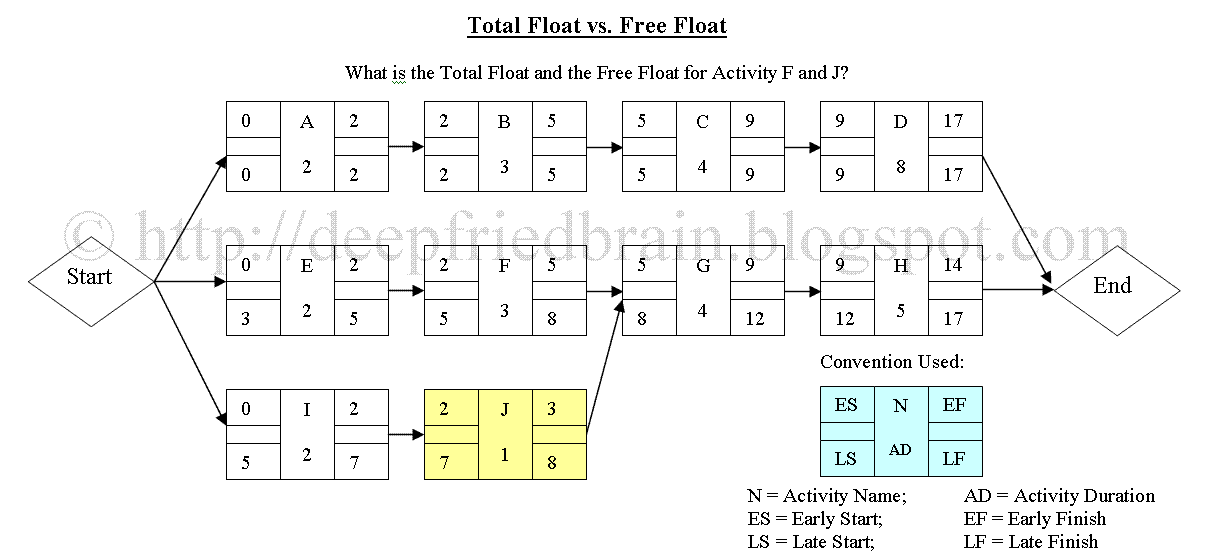
Let’s understand the concepts with the help of an example. Refer to the Network Diagram in the figure first. I’m assuming that you know how to work with a Network Diagram and how to calculate ES, EF, LS, and LF for activities on a Network Diagram. Click on the figure to download the network diagram as a PDF file.
Problem
What is the Total Float and the Free Float for Activity F and J?
Solution
The calculations are really simple.
For Activity F:
Total Float = LF of F – EF of F => 8 – 5 = 3

Free Float = ES of G – EF of F => 5 – 5 = 0
For Activity J:
Total Float = LF of J – EF of J => 8 – 3 = 5

Free Float = ES of G – EF of J => 5 – 3 = 2
Pro Tip
Free float can only occur when two or more activities share a common successor, or in other words, when activities converge on a Network Diagram. In our example, only activities F and J can have Free Float.
In the next section, let’s address the question posted by Dr. PDG in the comments.
Who owns Total Float and who owns Free Float?
Total Float belongs to the project, whereas Free Float belongs to individual activities. If the project is being done under a contract, it’s debatable whether Float belongs to the buyer or seller.
How should the Project Manager use Float on the project?
‘Float’ is a project resource. It should be used judiciously, mainly to cover the risks or other unforeseen issues on the project.
Float is a project resource.
Hope you’ll do well if you get such a question on your exam. If you have any doubts, I’m here to help.
While you are at it, also learn about Negative Float.
Image credit: Flickr / miguelvirkkunen
47 Comments
Moderated — submissions appear after approval.
- Dr. PDG imported
Now that you have done a fine job clarifying the differences between Total and Free Float, how would or could or should a professional project manager USE free and total float? Who owns total float? Who owns free float? My real complaint with the PMP exam (and PMI's approach in general) lies with the fact that while people may know the terminology and in some cases, may actually know how to do various calculations, they haven't a clue as to how to effectively use this information to manage projects. BR, Dr. PDG, in Boston http://www.getpmcertified.com
- Harwinder Singh imported
Hi Dr. PDG, Once again, you have challenged us 'mortals'. I'll give my short answer and let you elaborate. Total Float belongs to the project, whereas Free Float belongs to individual activities. If the project is being done under a contract, it's debatable whether Float belongs to the buyer or seller. In either case, 'Float' is a project resource. It should be used judiciously, mainly to cover the risks or other unforeseen issues on the project. Now I pass the ball to you. Please enlighten us more on this subject. 2. Regarding your point on the PMP certification, I think we are on the same page. Nobody is claiming that PMI-certified PMs are "Super PMs". I see it more as an academic qualification (similar to a school or college degree). Again, I have had this debate so many times in various forums and really tired of it. There's no end to it ... Thanks once again. I appreciate all your inputs.
- Dr. PDG imported
Not too bad an answer, Harwinder!!! I am impressed. From a claims (legal precedent) perspective, unless otherwise stated in the contract, float is generally considered to be owned 50% by the owner and 50% by the prime contractor. However, the 50% owned by the prime contractor is also split between his/her subs and vendors. And although you are absolutely correct that float is to cover or mititage risk, a better or more complete answer would be that it shows you how much flexibility you have in terms of both time (spread between early and late date S curve horizontally) and in terms of resources (the spread vertically between the early data and late date S curves) Very few people, unless they have been involved in litigation, truly understand how to effectively use float information to better manage their projects. BR, Dr. PDG, in Boston http://www.getpmcertified.com
- Dr. PDG imported
PS: For those really interested in this topic, be sure to download the many free Recommended Practices (RP's) AACE offers. http://www.aacei.org/technical/rp.shtml . Pay special attention to 29R-03 to learn about many of the games contractors play with schedules. And if you are interested in project controls/PMO as a career path, I urge you to move beyond PMI's rather sophomoric credentials and challenge yourself to some very difficult, albeit less well marketed credentials that AACE offers. http://www.aacei.org/certification/ BR, Dr. PDG, in Boston http://www.getpmcertified.com
- Nhlosenhle zwane imported
Dear Dr PDG My name is Nhlosenhle Zwane a current student in Project Management. I am experiancing a challenge in the PERT systerm, CPA and the network diagramme on an assignment we were given. Can you assist me please. I can be contacted on the following email: nhlokoz@gmail.com. Your Assistance will be highly appreciated
- MS imported
Nice explanation ... confused OR student
- Anonymous imported
I have a related question, which I m slightly confused about. Each of the books Rita, Head first and others have 2 different ways of drawing the network diagram..e.g Activity A starts on Day 1 and has a duration of 5 then the ES of the activity A is 1 and the EF is 6....and Activity B which proceeds activity A has a duration of 8, then Activity B, then the ES for B is 6 or 7 considering there is no lag between A and B. Same way while calculating LF and LS some authors subtract a day by default others don't...which is confusing...If you can kindly help with this, with an example that will be very helpful. In the end for calculating float it doesn't make any difference as adding 1 and then subtracting it correspondingly adjusts for the same. What is the standard practice for this, can you please clarify?
- Harwinder Singh imported
@ Anonymous: That's an excellent observation. I have answered this question previously in a forum too, but can't dig out the link right now. I'll answer it here again. You are right. Different books follow different conventions. Whether you start the first activity at 0 or 1 is a matter of choice. Both methods will get you the same answers. It doesn't make any difference when it comes to calculating the duration of critical path, and float values. I prefer to follow the convention that which you find in Rita's book, to calculate the ES, EF, LS, LF, FF, TF. The advantage with this convention is that you don't need to add/subtract hours. The first day starts at 0. If the first activity's duration is 7 days, then its ES = 0 and EF = ES + Duration = 0 + 7 = 7. The successor activity will have the ES = EF of the predecessor activity (provided there's no lead or lag). In summary, pick the convention that you are more comfortable with, practice it, and stick to it. Hope it answers your question. Thanks for bringing it up.
- Chelluri imported
Harry, i was bit puzzled to use 0 or 1 to calculate the ES of the first activity.. But after seeing your explanation, now i am clear on using 0 or 1. Thank you
- SOUMIT imported
If an activity x, ES = 1 and duration =5, EF = 1+5=6. ES for activity (x+1)=6. However, I have seen calculations, where EF(x) will be 5 (1 through 5 = 5days). then ES(x+1)=6 (not 5). Both these methods will not make any difference to your CPM calculations as long as you keep it constant throughout. But, in ur PMI certification exam, this can make a difference because you have to choose what PMI thinks is correct from the given options. Use the latter I think.
- williams rodriguez constantino imported
Definitivamente son terminos que son necesarios comprender a fondo para darles la aplicacion correcta en nuestros proyectos, agradezco mucho los comentarios y los felicito... :D
- Harwinder Singh imported
Hello Williams, I cannot read Spanish. So, I translated it to English for others' and my own benefit. Here's what it translated to: "They are definitely terms that are necessary to fully understand them correctly applied in our projects, I very much appreciate the comments and I congratulate ... : D" Thanks for your comments :)
- Rookie imported
Continuing from Soumit's comments on 28 March, I'm sharing this link and a few questions. (link removed) This's the clearest description of the 2 conventions by far. It says: The Zero Method – all starts and finishes are at the end of a time period. In the Zero Method, the start of an activity has the same number as the finish of the previous activity on the critical path. The One Method - all starts are at the beginning of a time period and all finishes are at the end. In the One Method, the finish of a previous activity on the critical path, has 1 added to it to get the start of the next activity. It seems that - Rita Mulcahy uses the "zero method" - Andy Crowe uses the "one method" So 2 questions remain 1) Which one does PMI use? Any recent exam takers care to share your experience? 2) Are "zero method" and "one method" the official terms to describe these calculation conventions?
- Anonymous imported
the formula for FF = ES of next activity - EF is wrong it should be FF = ESn - ES - duration
- Harwinder Singh imported
Hello Anon., Thanks for your feedback. Please elaborate on the source of this information. BR.
- Anonymous imported
Another excellent source of information on PMP is the PM Road Trip and in particular the calculation for free float as put forward by anon is correct: FF = (ES of successor - ES of current - duration of current) This can be found here: http://www.pmroadtrip.com/pdm_01.html I prefer the "one menthod" as it is reflects the real world much better. I would never start the first activity on day zero as that doesn't make sense. You start on day 1 and if it takes 5 full working days to complete (duration) then you would be working on it on days 1, 2, 3, 4, and 5. Then the earliest you can start the next activity is day 6, not day 5!.
- Shraddha imported
This comment has been removed by a blog administrator.
- Harwinder Singh imported
Hello Shraddha, I had to remove your post because it violates PMI's code of conduct. Try to rephrase your question and post it again. Thanks.
- Anonymous imported
I think both of th efollowing are same FF=ES of next activity -EF of current - (1) FF = (ES of Successor -ES of current -Duration of current) - (2) here is the explaination From (2) above FF =(ES of Successor -ES of current -Duration of current) which means FF =(ES of Successor -(ES of current +Duration of current)) and -(ES of current +Duration of current) = EF of current so it becomes FF =(ES of Successor -EF of current) whcih is same as (1) so formula is harry's post is same as what annon has posted.
- Anonymous imported
Hi, I have another question regarding identifying float and utilizing it as a buffer/slack. In case of leads and lags to N/W diagram, how should float be identified? For example, it might be required to wait for 2 days before Activity B starts after Activity A, say due to planned maintainance. If we just go by float calculation, this may be considered as a buffer that can be utilized. So how to really identify fload in case of leads and lags?
- Muhmad imported
Thanks Harwinder for your wonderful example
- Ram imported
Harwinder, I would like to know about Project float ( Rita's book).As per my understanding there is no float for critical path activities.If this is correct.Does Project float existis?. And How do we diffrenciate float with leads and lags! Thanks Ram
- Anonymous imported
Excellent job clarifying the concept. My students have had a lot of trouble understanding this but now it crystal clear. Thanks
- Anonymous imported
I CAN NOT UNDERSTAND HOW TO CALCULATE ACTIVITY DURATION IN CASE OF RLLATION IS FF -2 OR FS +3 FOR EXAMPLE CAN YOU EXPLAIN PLEASE
- Parsa Mahmoudzadeh imported
HI, Harwinder, I think you are right for the most part, let me elaborate a little bit more; Free Float belongs to every activities done before the target activity we concern about. actually, Independent Float is belong only to one activity itself.
- Amit Ranjan imported
I agree with Dr. PDG.... But, for this we should also favors that Project Planning Tools supports, if all stake holders will have believe & directed only from PMO Office
- shameer e.v imported
In my opinion....FLOAT is an asset of the project and NOT for the exclusive use/benefit of the Contractor.
- Anonymous imported
Thanks, your example helped
- Hamid Samadani
Excellent explanation! Thank you.
- Harwinder Singh
Thank you, Hamid. Glad you found it useful.
- Jalal To'ma Nimri
perfect <3
- Harwinder Singh
Thank you, Jalal. Glad you loved it.
- zomuana
Thank you very much for your clear and concise explanation especially with example..
- Richard
It is helpful. But I need clarification on where resounces can be used when allocation.
- Bikalpa Dhakal
Thank you for this explanation. It cleared my doubts.
- Harwinder Singh
I'm glad to hear it helped. Thanks for your feedback.
- RADHAKRISHNAN MURUGAMANICKAM
Excellent. In Free Float = ES of next activity - EF - 1 (please add (-1), which will help beginners)
- Harwinder Singh
There's no (-1). Don't confuse the beginners :)
- Amit
Hi - Thanks for your example, very helpful. So if you have no free float between activity G & F then you cant delay task F, however if you have 2 days of float between G & J then you can delay activity J upto 2 days ?
- Harwinder Singh
Hello Amit, Glad you found the example useful. Your statement is almost correct. F can't be delayed "without delaying G", but J can be delayed by up to 2 days "without delaying G". Free float is the time by which an activity can be delayed without delaying its successor(s). But Total Float means F can be delayed by up to 3 days without delaying the project, and J can be delayed by up to 5 days without delaying the project. Hope this makes sense.
- RM
Total Float is owner by the contractor , Preapproval required by the project company in order to use it .
- Nelly
What is the relevance of slack /float in project optimization?
- Harwinder Singh
Nelly, great question! I believe it''s addressed in the comments above. Refer to the chain of comments starting from the first comment by Dr. PDG.
- Deepak Rajvanshi
Thanks a lot !!! Thi is the the simplest and best definition. Easy to understand.
- Harwinder Singh
Thank you, Deepak. I'm glad to be of help.
- ahmed
I need to Calculate Free Float for D and H activities
- Pratibha 'KD'
Thank you so much for this wonderful and simple explanation.