· Harwinder Singh · PMP · 4 min read
To-Complete Performance Index (TCPI) in Earned Value Management (EVM)
What is To Complete Performance Index (TCPI) in Project Cost Management? In this post, we'll learn the definition of TCPI, TCPI Formula and calculations using simple examples.
To-Complete Performance Index (TCPI) is an Earned Value Management (EVM) concept first introduced in the PMBOK Guide, Fourth Edition. When I first read the description of TCPI in the PMBOK Guide, I couldn’t make much sense of it. After reading up more on the subject, I was surprised to realize that the concept is really simple to understand, especially if you are a Cricket (sport) fan. I can explain the TCPI concept to you in just 3 words. Yes, it’s really that simple. The concept is exactly the same as that of Required Run-Rate in Cricket.
What is To-Complete Performance Index (TCPI)?
According to the PMBOK Guide, the to-complete performance index (TCPI) is a measure of the cost performance that is required to be achieved with the remaining resources in order to meet a specified management goal, expressed as the ratio of the cost to finish the outstanding work to the remaining budget.
In simple terms, TCPI is the cost performance that must be achieved on the remaining work to meet a BAC (or EAC) target. It is the ratio of “remaining work” to the “funds remaining”.
Example of TCPI
If you are not familiar with Cricket, the most intellectual outdoor sport, skip the Cricket match example and read the remainder of the post.

Let’s take an example of a 50 over One-Day game between India and Australia. Assume that Australia batted first and scored 299 runs in 50 overs. So, India needs to score 300 runs in 50 overs. What’s the required run rate for India? It’s exactly 6 runs per over (rpo) at the start of India’s innings.
Now say after 30 overs, India managed to score only 120 runs. So, the current run-rate is 4 rpo. What’s the required run-rate after 30 overs?
Required Run-Rate = Runs remaining to be scored / Overs remaining
=> (Total Runs to score - Runs already scored) / (Total Overs - Overs used) => (300 - 120) / (50 - 30) => 180 / 20 => 9 rpo
So, India is going at 4 rpo, but needs to score at 9 rpo for the remaining 20 overs to win the game.
TCPI in Project Management
Now apply this analogy to Project Management.
Current Run-Rate ~ Cost Performance Index (CPI)
Required Run-Rate ~ To-Complete Performance Index (TCPI)
To-Complete Performance Index (TCPI) Formula
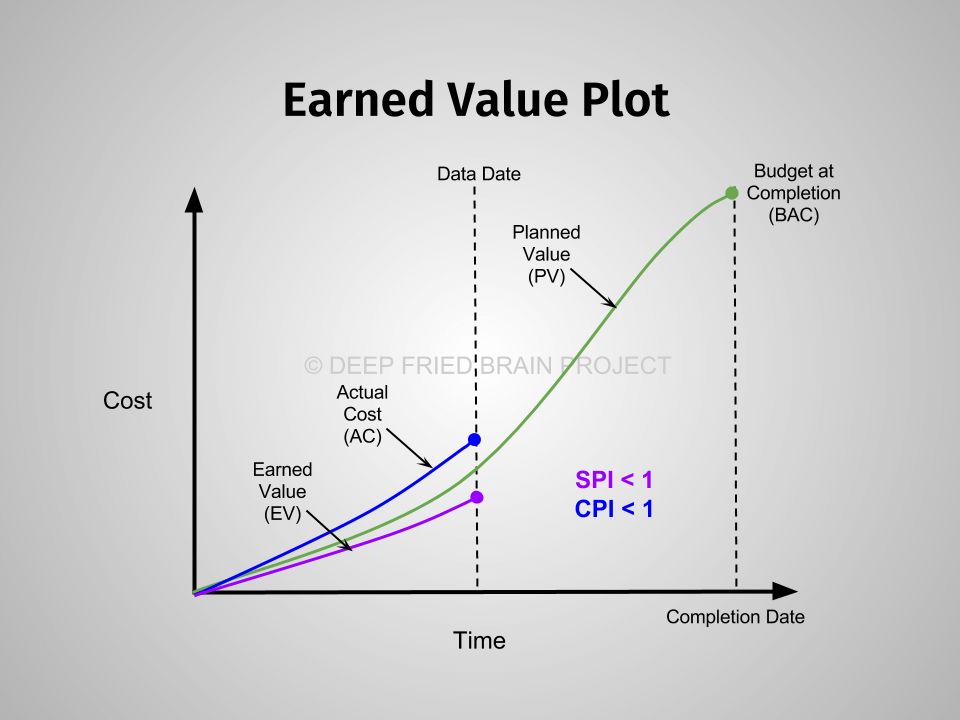
To-Complete Performance Index (TCPI) is calculated by dividing the work remaining on the project by the money remaining. There are 2 different formulas to calculate TCPI. We’ll review both. Suppose your total project budget (Budget At Completion or BAC) is $300. Three days into your project, you spent $180 (Actual Cost or AC) on work that was estimated to cost only $120 (Earned Value or EV).
Therefore, CPI = EV / AC = 120 / 180 = 0.66
CASE 1
You need to complete the project within the original budget. In this case, the TCPI formula is:
TCPI = Work Remaining / Money Remaining = (BAC - EV) / (BAC - AC)The worth of remaining work = $300 - $120 = $180
And, the money remaining = $300 - $180 = $120
TCPI = (BAC - EV) / (BAC - AC) => ($300 - $120) / ($300 - $180) => $180 / $120 => 1.5
In summary, you are going at a CPI of 0.66, but you need to go at a CPI of 1.5 for the remaining work on your project, in order to meet your original cost estimate.
CASE 2
You (as a Project Manager) realize that the original estimate was fundamentally flawed and/or it is not feasible to meet the original cost estimate. You develop a new cost estimate for the remaining work and get it approved. With the new estimate, your revised project budget (EAC) is $450. In this case, the TCPI formula is:
TCPI = Work Remaining / Money Remaining = (BAC - EV) / (EAC - AC)=> ($300 - $120) / ($450 - $180) => $180 / $270 => 0.66
In summary, you can continue to go at your current CPI of 0.66 and complete the remaining work on the project and still meet the revised cost estimate.
Just in case you were wondering about the result of India-Australia game, of course India won, and with an over to spare !
Image credit: Wikimedia Commons
14 Comments
Moderated — submissions appear after approval.
- Cyno imported
bubesGood example :) Regarding the calculation of EAC, there are many ways to calculate this. Can you please elaborate or relate the formulas and assumptions.
- JohnV imported
Excellent Analogy ! one Q -, in case of EAC based TCPI, would the schedule get impacted , i mean would the schedule be delayed ?
- Harwinder Singh imported
Hello Cyno, Thanks for your feedback and suggestion. I'll do a post on the EAC calculations soon. Thanks !
- Harwinder Singh imported
Hello JohnV, Thanks for your feedback. TCPI is about cost performance on the project. It does not consider schedule performance. So, the answer is 'No', the schedule doesn't get impacted. Thanks !
- vj imported
Harwinder, As you replied for the question related with EAC based TCPI that the schedule won't be impacted.. however, i have some doubt on this. If we take the example of cricket, if the target was 300 and at the end of 30th over, we have made 120 runs at the run rate of 4 per over, if we continue with the same run-rate then we would be able to make 300 runs in 75 overs, which means schedule would get impacted. Is not it ?
- Harwinder Singh imported
Hello VJ, That's an interesting comment. First of all, if a project is above cost, it doesn't necessarily mean it's behind schedule also, and vice versa. That's why we have 2 indicators - Schedule Performance Indicator (SPI) and Cost Performance Indicator (CPI). TCPI is the "required" CPI for the rest of the project. TCPI doesn't consider the schedule performance. Now going back to the analogy with Cricket, you have to compare the overs with the cost, not schedule. In order to win the match, we don't get more overs, but we need to score quickly. If we don't score quickly enough, we lose the game. Translating that into Project Management, either we improve the cost performance on the project, for the rest of the project (Case 1), or we'll run out of budget, before the project completes. Other option (Case 2) is to re-estimate and request for more budget to complete the project. That's where EAC comes into picture. In Cricket, we can't say that because the pitch conditions have changed in the second innings, we need more overs to win the match. So, the analogy with Cricket is only limited to Case 1 (where we calculate TCPI based on BAC), and not to Case 2 (where we base the TCPI on EAC). Feel free to post additional comments if it's still not clear. Thanks.
- vj imported
Thanks Harwinder for your detailed explanation. So, in case of EAC based TCPI, 1) It is certain that always the cost of the project would get impacted means cost of the project would get increased, right ? 2) I think EAC based TCPI should make sense only if by putting extra cost we are able to meet the schedule. Else we are looser on both the front , cost as well as time. Is there any formula, which can make sure that even though the cost of the project is increasing (as calculated by EAC based TCPI), the schedule are met i.e. SPI is greater than or equal to 1. SPI = EV / PV, if SPI >= 1, then EV should be >= PV. Now CPI = EV / AC, As per EAC based TCPI, AC would be more than EV or we can say that AC would be more than PV. EV = AC x CPI, from the SPI formula, EV= PV x SPI So, PV x SPI = AC x CPI, or SPI / CPI = AC / PV since AC is greater than PV, so, SPI / CPI >= 1 So, SPI >= CPI Please mention your comments. Thanks in advance
- Harwinder Singh imported
Hi VJ, I don't think I understood much of your calculations, but I think I understand your points to some extent. 1. In most cases, yes, the cost would get increased, but I can imagine the reverse happening too. What if you overestimated the project costs in the beginning? 2. Your second point is valid. However, it is one of the several ways of calculating EAC. If your project is over budget and you still want to meet the schedule deadline, then you can calculate EAC this way: EAC = AC + ((BAC - EV) / (CPI * SPI)) This method takes both the cost and schedule performance into consideration when calculating EAC. I guess this is what you were looking for when you said "is there any formula which can make sure that even though cost of the project is increasing, the schedule is met?". I'll do a more elaborate post on calculating EAC very soon. Thanks.
- Vikas Jain imported
Hi Harwinder, As per PMBOK , EAC = AC + Remaining Value of the project EAC = AC + (BAC -EV) ---------------- ( 1 ) However, in some of the books and also as per wikipedia ( http://en.wikipedia.org/wiki/Earned_value ), EAC = BAC / CPI ---------------------------- ( 2) If we calculate EAC by method ( 1) and method ( 2) then there is a difference in the value of EAC. My query is, when we use methoed (1) and when method (2), to calculate EAC. It would be great if explanation could be provided with some example. Thanks ! Vikas
- Harwinder Singh imported
I've addressed the EAC calculations in this post: Estimate At Completion (EAC) vs Estimate To Complete (ETC)
- Chelluri imported
Harry.. Great example to explain TCPI with excellent correlation.. I will never ever forget the logic behind TCPI. Btw, i am not sure India won that match.. :)
- Santosh Mukund Nemawarkar
Excellent simplified explanation. There is quote , If you can not make others understand then you have not understood the mater. I have gone through many PMP related topic's explanation provided here and I can bet that the way it has been explained makes it very easy and to correlate the examples with real life situations. Thanks and great efforts being put to simplify the complex jargons.
- Harwinder Singh
Thank you so much, Santosh. I'm very humbled by your comments.
- aconex oracle
As part of the process, project stakeholders are alerted to problem areas that can put the project at risk throughout its life cycle. It enables them to make adjustments ahead of time to prevent the project deviate from the original plan.