· Harwinder Singh · PMP · 4 min read
Solving the Estimate At Completion (EAC) Puzzle
In this post, we'll compare two formulas for calculating Estimate at Completion (EAC) in Earned Value Management (EVM) as part of project cost estimation.
 In an earlier post, we reviewed four formulas for Estimate At Completion (EAC) mentioned in the PMBOK® Guide, 6th Edition, and when to use each of them. Just when I thought I had it all covered, a keen reader published a question about another EAC formula that I had not mentioned. The formula was EAC = AC + (BAC - EV) / CPI. Sure enough, I didn't have it covered. If this formula isn't mentioned in the latest edition of PMBOK Guide, does it even exist or is it a work of imagination? Read the complete article to find the answer.
When I saw the formula, my first reaction was to open the PMBOK Guide, Fourth edition and check whether it’s even legitimate. Of course, it wasn’t there. Otherwise, I would have covered it in my previous article. Next, I called upon my trusted friend, Google. The very first result eradicated my doubt. The formula was indeed legitimate. But, why wasn’t it mentioned in the PMBOK Guide, Fourth Edition? I started looking around for clues. Soon, I found the missing piece of the puzzle. It was lying inside the previous edition of the PMBOK Guide (Third Edition). Now I had the answer. Let’s see what it is.
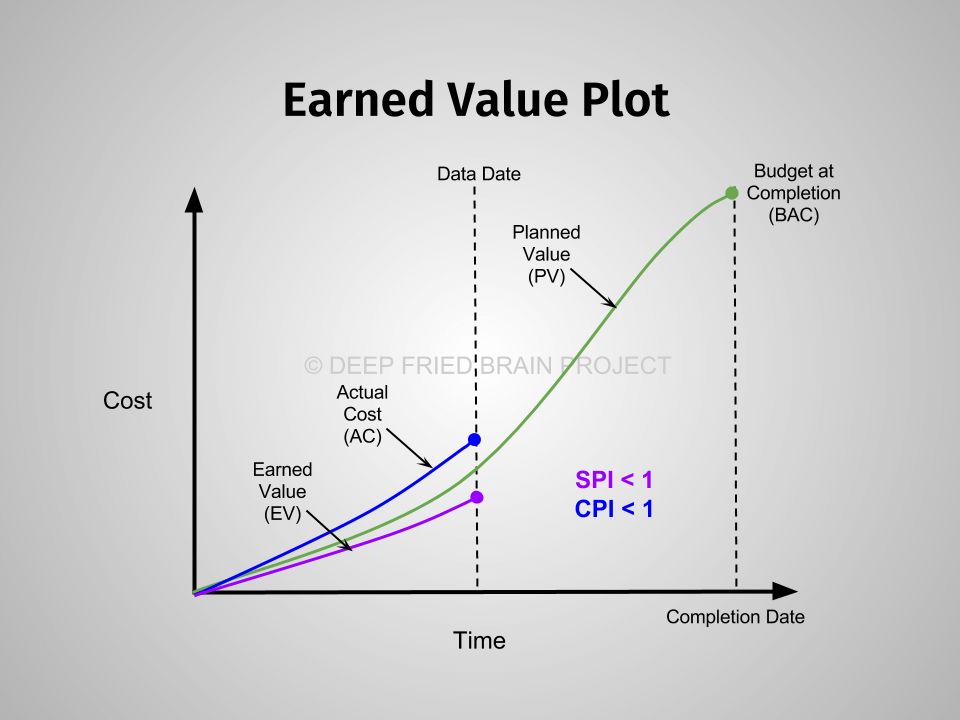
More important than learning the EV formulas is to understand them. As usual, let’s begin with an example. We’ll use the same simple example we used in the earlier post. The project involves constructing a boundary wall around a square piece of land. The planned cost for each side is $1000 and it’s estimated to take one week to construct each side. Budget At Completion (BAC) is $4000 (= 4 x $1000). Let’s say that at the end of week 1, we completed only 80% of the first side and spent $1200 on it.
Planned Value (PV) = $1000
Earned Value (EV) = 80% of $1000 = $800
Actual Cost (AC) = $1200
Formula for Schedule Performance Index (SPI)
Schedule Performance Index (SPI) = EV / PVCalculate SPI by substituting EV and PV:
SPI = $800 / $1000 = 0.8Formula for Cost Performance Index (CPI)
Cost Performance Index (CPI) = EV / ACCalculate CPI by substituting EV and AC:
CPI = $800 / $1200 = 0.66As you can see, we have completed only $800 worth of work in one week and spent $1200 on it. Assuming that the current variances are typical, and are expected to continue for the rest of the project, to accomplish $4000 worth of work, it’s going to take us 5 weeks and cost us $6000 ($1200 x 5). Therefore, our EAC is $6000.
Now, we’ll calculate EAC using a formula. As per PMBOK Guide, Fourth Edition, the EAC formula for ‘typical’ variances is:
EAC = BAC / CPI ... (1)Substituting the values, we get:
EAC = $4000 / 0.66 = $6000Notice that the value of EAC is the same as we derived without the formula. Now let’s have some fun with this equation. If we add and subtract EV in the numerator of the equation, we get:
EAC = (EV + BAC - EV) / CPINow, split the fraction on the right hand side:
EAC = EV / CPI + (BAC - EV) / CPIWe also know that CPI = EV / AC. Therefore, AC = EV / CPI. Let’s substitute EV / CPI with AC in the EAC equation above and we get:
EAC = AC + (BAC - EV) / CPI ... (2)Hey, wait a minute. Isn’t equation (2) the same as the one our keen reader pointed out? As it turns out, PMBOK Guide, Third Edition specified EAC = AC + (BAC - EV) / CPI for ‘typical’ variances. The fourth edition of the Guide, simplified the equation to EAC = BAC / CPI. Both equations (1) and (2) are the same. I’ve seen lot of confusion around the EAC formulas among PMP aspirants, in online forums too. I hope you find this information useful and pass it along to others who face similar doubts.
Do you have other doubts about Earned Value formulas? Feel free to post your questions.
Image credit: Lumaxart
11 Comments
Moderated — submissions appear after approval.
- hundi imported
Harwinder, Just saw your article on the EAC formula. I think you have covered more than any other books can cover, including Rita Mulcahy. Each and every book just parrots "typical" and "atypical" variance without bothering to give a clearcut explanation. I figured the difference outr just a week before the exam, however i did not notice , BAC/CPI = AC+ (BAC-EV)/CPI this is very good find. Regards, sujeeth
- Chelluri imported
Harry.. As a PMP aspirant, most of the time im considering PMBOK 4th edition as the main source. But, you made me revisit PMBOK 3rd edition. As sujeet mentioned, i just noticed BAC/CPI = AC+(BAC-EV)/CPI.
- Derek Huether, PMP imported
Excellent post and excellent job bringing this to light. I've also discovered the Variance At Completion (VAC) formula (VAC = BAC – EAC) missing from the PMBOK 4th but in use (and documented) elsewhere. For those aspiring toward their PMP, PMI would have helped matters if they would have included a section in the glossary for commonly used formulas. Regards, Derek
- Harwinder Singh imported
Thanks Sujeeth and Suresh (Chelluri) for the comments. @ Derek: I agree. I had skimmed over your post about variance formula, but haven't been able to take a closer look at it. I also noticed the question you tweeted about it. I'll exchange more ideas with you once I get around it. I look forward to learning more from you. Thanks.
- Phil imported
I saw another variation of EAC, which is used for CPI and SPI consolidation....not clear on what that means...but the formula is EAC = AC + (BAC-EV) / (CPI*SPI) Has anyone seen this before and know what it means?
- Harwinder Singh imported
Hello Phil, I've explained that formula here: Estimate At Completion (EAC) vs Estimate To Complete (ETC) Does that help? Thanks.
- Anonymous imported
Hi, Thanks a lot for the excellent approaches. Regarding Equation #1 ... Would you please let us know why did you choose typical equation ? instead we should use atypical equation for EAC as both indicies are < 1 ? EAC = AC + BAC - EV Yahya Wadi
- Ram imported
Harwinder, Gereat Blog for PMP aspirants.I have little diffrent approach. EAC = AC+(BAC-EV)/CPI -- This our equation. Now take LCM EAC = [(AC*CPI)+(BAC-EV)]/ CPI We know CPI= EV/AC, EV= AC*CPI Substitute EV in place of AC*CPI We arive at EAC = [EV+(BAC-EV)]/ CPI -- cancle EV,-EV EAC = BAC/CPI Hope I have clear. Ramaraju
- Harwinder Singh imported
Hello Ram, You are just doing the same thing in the reverse order. But it's fine. Regards.
- Sameer imported
But when I calculate value of EAC why it is coming different. If I use EAC=BAC/CPi it comes to 6000 if i follow your theory then mathematically the value should be same with the formula which is EAC= AC+(BAC-EV)/CPI it comes to 6048 why?
- Marco Poletto imported
They say it is the cost for ending up in time... but i really can't understand: BAC/CPI is the new cost with new performance. You can add people and end up before (that is: you do not have to pay the original ones after the deadline), or you can let it go and end it up late. But you always pay BAC/CPI... so this kind of explanation does not make sense. I cannot resolve this but i think the real idea of this formula is: production is not linear with number of workers userd, it is quadratic. That's why you need to "double" the effect of time.